What does great product marketing look like?
Teams can do all the right activities and still end up with disconnected marketing. They study their ideal customers, gather competitive intelligence, work on positioning, and design a narrative. But the pieces never quite fit together. The website tells one story. The sales deck tells another. The next campaign starts from scratch.
I built the Jellyfish Model to make those connections visible. It shows how customer and product insights become positioning, how positioning becomes a narrative, and how that narrative comes to life across your marketing.
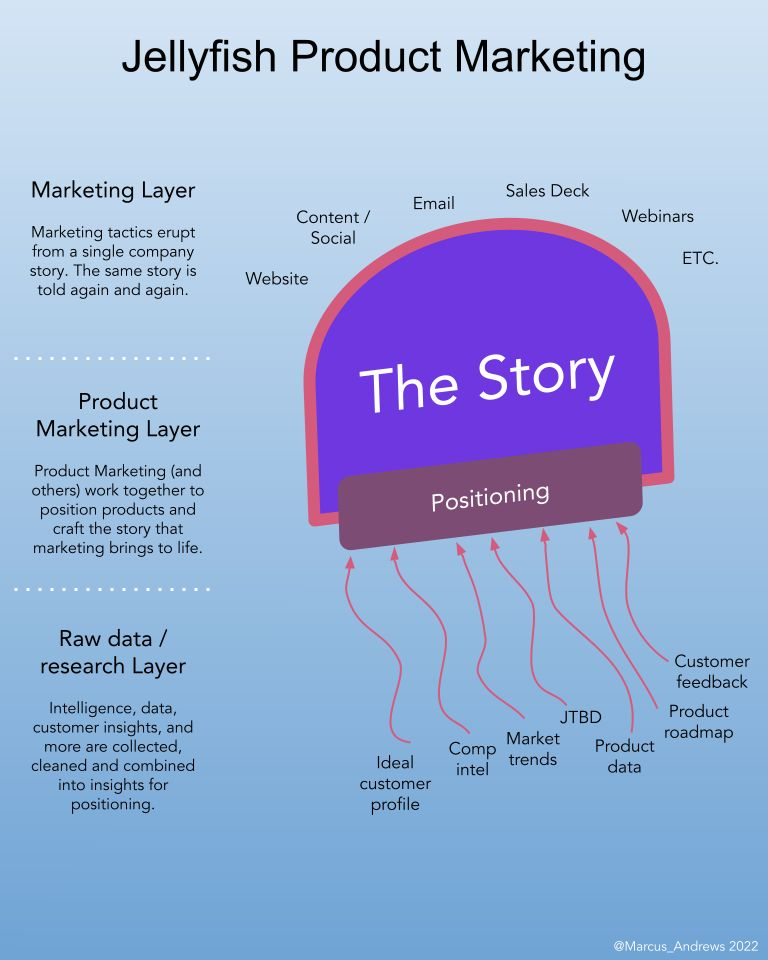
There are three layers: raw data and research, product marketing, and marketing. Each involves several teams, but each also needs someone to lead it. The model makes both the order of the work and the handoffs easier to understand.
Why a jellyfish?
When I first drew this model, my three-year-old was obsessed with sea creatures. We read about them, drew them, sang songs about them, and talked about them. A lot. So it’s probably no surprise where my mind went during a whiteboard session about product marketing.
I was trying to visualize three ideas:
- Great positioning is the foundation of a great narrative. You can tell a good story without positioning. But it may communicate the wrong value, about the wrong product, to the wrong buyer. Positioning helps you tell the right story.
- A narrative brings positioning to life. Positioning might live in a one-page internal document. A narrative can become a keynote, a book, or a content strategy that a company builds on for years.
- Meaningful research makes positioning possible. Customer insights, product knowledge, and market intelligence give you something solid to build on.
I drew the research inputs underneath positioning, added the story above it, and stepped back. It looked like a jellyfish.
The value is in the connections between the layers.
The raw data and research layer
Start at the bottom. Before you can position a product, you need to understand what it does, who needs it, what alternatives they have, and where it’s headed. The tentacles in the diagram represent the different sources of intelligence that feed this work.
In a B2B software company, I look to Product to lead this layer. A product manager will often have much of this information for their product already. Sales, Customer Success, research teams, and Product Marketing all contribute. The work is collecting what those teams know and turning it into shared insights.
Seven places to start
- Ideal customer profile. Which accounts can’t live without your product? Which are a bad fit? Look for the characteristics that make the difference, using what Sales and Customer Success hear as well as what Product observes.
- Competitive intelligence. Understand all the alternatives. The biggest competitor may be a spreadsheet, a manual process, or simply doing nothing.
- Market trends. What is changing in your space? Look at emerging strategies, changes in behavior, and practices people are leaving behind.
- Jobs to be done. What do customers hire your product to accomplish? Describe the job in their language, with enough context to understand when and why it matters.
- Product data. How do people actually use the product? Which features matter to different customer segments? Where do people find value, and what gets ignored?
- Product roadmap. Where is the product headed, and why? Understanding the strategy helps you set up a story the product can support.
- Customer feedback. What do customers ask for? What frustrates them? What do they rarely mention, and why might that be?
The output is a set of insights you can use to make choices. Collecting data alone doesn’t get you there. Compare what customers say with what they do, look for patterns, and make the implications clear to the people doing the positioning.
The product marketing layer
This is where the research becomes positioning and the positioning becomes a story. Product Marketing typically leads, working closely with Product and company leadership.
Positioning gives the story its foundation
Positioning answers basic but demanding questions: What is the product? Who is it for? What makes it valuable compared with the alternatives? The research layer gives you the evidence to answer those questions well.
A lot of that work starts while Product is still developing a feature. If the team has identified a clear customer problem, tested a solution, and learned from feedback, Product Marketing has something substantial to work with. Join that process early.
I’ve used April Dunford’s work to build positioning workshops with product teams. Her approach is a useful starting point for making those choices explicit and getting people aligned around them.
Narrative gives the positioning room to grow
A narrative is a way of looking at the world. It helps customers understand a change, what it means for them, and how they can adapt. That gives your product a meaningful role in a much larger story.
Narrative Design for Business is the framework I built for this part of the work. Its five steps help you move from a change in the customer’s world to the solution you’ve built to help.
Product marketers can drive this effort, but they need leadership to believe in it. The CMO, CPO, and CEO need a shared understanding of how positioning and narrative will guide decisions. Without that support, the work can become a document everyone agrees with and nobody uses.
The marketing layer
At the top of the jellyfish, the story becomes visible: your website, content, social posts, email, sales decks, webinars, and campaigns. Marketing leads the execution, with Sales and other teams carrying the same ideas into their own work.
The mistake I see most often is disconnected tactics. A blog post might be well written, a webinar interesting, and a campaign effective at capturing leads. But if each one drifts away from the product and ideal customer, those activities don’t add up to a useful whole.
A shared narrative gives them a common origin. Every piece can explore a different part of the story while reinforcing the same point of view.
Not every tactic needs to tell the complete narrative. But they should all be born from it.
Think about a tree: the core narrative is the trunk, and the individual stories are the branches. A blog post might explore one impact of a market change. A webinar might teach the new approach. A sales deck might explain the obstacles and show how your product helps. They have different jobs, but you can trace each one back to the same story.
Putting the model to work
Use the diagram to walk through one product with your team, from the bottom up. Make the connections concrete before trying to apply it across the whole company.
- Bring the research together. Ask Product, Sales, Customer Success, and Product Marketing what they already know. Find the gaps that would prevent you from making a positioning decision.
- Agree on the positioning. Use those insights to define the customer, alternatives, and value. Resolve disagreements while the choices are still easy to change.
- Design the narrative. Build a story grounded in that positioning. Explain the customer’s world and how they can succeed in it.
- Connect the execution. Take a few planned campaigns or existing assets and identify which part of the narrative each one advances. If the connection is unclear, revisit the idea.
- Keep listening. Bring customer reactions and product learning back into the research. Revisit your choices when the evidence changes.
It helps to name a lead for each layer and the decisions each group needs from the others. A handoff should carry the reasoning as well as the output. A campaign team needs to understand why the story matters, not just receive a new set of words.
Good marketing that’s bad
It’s possible to make marketing that looks good on its own and still does little for the business. It can be creative, interesting, well written, and successful at generating attention, while remaining disconnected from the product and customers.
The Jellyfish Model gives you a way to examine that disconnect. Can you trace a campaign back to the narrative? Does the narrative reflect the positioning? Is the positioning supported by research?
If a link is missing, start there. Producing more content won’t fix an unclear story, and polishing the story won’t fix positioning built on weak assumptions. The point of the model is to help teams understand how they contribute to one connected effort.
Going deeper
The Jellyfish Model maps the overall approach. Read the Narrative Design guide for the process of building the story at its center.
- My original introduction to the Jellyfish Model on LinkedIn
- The original Jellyfish Model slides
- More of my writing on marketing and narrative
If you put it to work, I’d love to hear what connected and where you got stuck. Get in touch.